Why I Unfollowed 500 People to Save the Planet (and My Sanity)
In early 2026, I realized my smartphone wasn't just a communication tool—it was a personal exhaust pipe. Every like, every auto-play video, and every unread newsletter sitting in my inbox was contributing to a massive, invisible infrastructure of data centers that consume as much electricity as small nations.
The Hook: We talk about plastic straws and electric cars, but we rarely talk about our "Digital Carbon Footprint." I decided to delete 500 followers and 20 apps. Here is what happened.
1. The Invisible Cost of a "Follow"
Every time you follow an account, you trigger a chain reaction. Algorithms must now process more data to show you their content, and those videos are stored on high-powered servers. By unfollowing 500 inactive or "noise" accounts, I reduced the constant data requests sent to my device.
4g CO2Per Email Sent
102kg CO2Avg. Annual Smartphone Impact
2. Reclaiming Mental Sovereignty
Digital minimalism isn't just about the planet; it's about your peace. Without 500 voices shouting for my attention, I regained nearly 2 hours of my day. I stopped "doom-scrolling" and started "deep-working."
3. Your 3-Step Digital Declutter Checklist
Audit Your Feed: If an account doesn't inspire or inform you, unfollow. Don't let "polite following" drain your energy.
The Email Purge: Use tools like Unroll.me or manual unsubscribing. Deleting 1,000 unread emails saves roughly 32kg of CO2 over a year.
Greyscale Mode: Turn your phone to black and white. It makes the "attention-grabbing" icons look boring, instantly reducing screen time.
The Result?
My focus has never been sharper. By choosing intentionality over infinity, I've created a digital life that serves me, rather than me serving it. The planet—and my brain—thanked me.
Delhi's Choking Crisis: Unpacking the AQI Disaster, Its Timeline, and The Road Ahead
Delhi's Choking Crisis: Unpacking the AQI Disaster, Its Timeline, and The Road Ahead
Delhi and its surrounding National Capital Region (NCR) face a recurring and severe environmental crisis: alarming levels of air pollution. Every year, as winter approaches, the air quality plummets to hazardous levels, turning the vibrant capital into a gas chamber. This post dives deep into the AQI issues, its causes, impact, and the collective efforts to combat this daunting challenge.
A typical smog-filled morning over Delhi, highlighting the severe air quality issues.
Understanding AQI: What Are We Breathing?
The Air Quality Index (AQI) is a yardstick used to report daily air quality. It tells you how clean or polluted your air is, and what associated health effects might be a concern for you. A higher AQI value indicates a greater level of air pollution and a greater health concern.
Good (0-50): Air quality is considered satisfactory, and air pollution poses little or no risk.
Moderate (51-100): Air quality is acceptable; however, for some pollutants, there may be a moderate health concern for a very small number of people who are unusually sensitive to air pollution.
Unhealthy for Sensitive Groups (101-150): Members of sensitive groups may experience health effects. The general public is less likely to be affected.
Unhealthy (151-200): Everyone may begin to experience health effects; members of sensitive groups may experience more serious health effects.
Very Unhealthy (201-300): Health warnings of emergency conditions. The entire population is more likely to be affected.
Hazardous (301-500+): Health alert: everyone may experience more serious health effects. This is often the category Delhi finds itself in during peak pollution periods.
Key pollutants include Particulate Matter (PM2.5 and PM10), Ozone (O3), Nitrogen Dioxide (NO2), Sulfur Dioxide (SO2), and Carbon Monoxide (CO).
The Genesis of a Crisis: A Timeline of Delhi's Air Pollution Woes
Delhi's air pollution isn't a new phenomenon, but it has escalated dramatically over the past two decades. Here's a simplified timeline of how the issue developed and key moments:
Early 2000s
Rising Concerns
Rapid urbanization and industrialization lead to a noticeable increase in smog and respiratory issues. Public awareness slowly begins to build.
2010-2015
The "Gas Chamber" Emerges
Scientific studies and reports increasingly label Delhi as one of the most polluted cities globally. Stubble burning in neighboring states identified as a major seasonal contributor. Diwali firecrackers add to seasonal spikes. Vehicular emissions remain a constant problem.
2016-Present
Emergency Measures & Public Outcry
Implementation of the Graded Response Action Plan (GRAP). Odd-Even scheme piloted. Supreme Court intervenes repeatedly. Public health advisories become common. International media highlights Delhi's plight, prompting global discussion.
Annually, October-November
The Winter Assault
Combination of stubble burning, festive firecrackers, unfavorable meteorology (calm winds, temperature inversion), and sustained local pollution sources leads to "Hazardous" AQI levels.
Key Contributors to Delhi-NCR's Foul Air
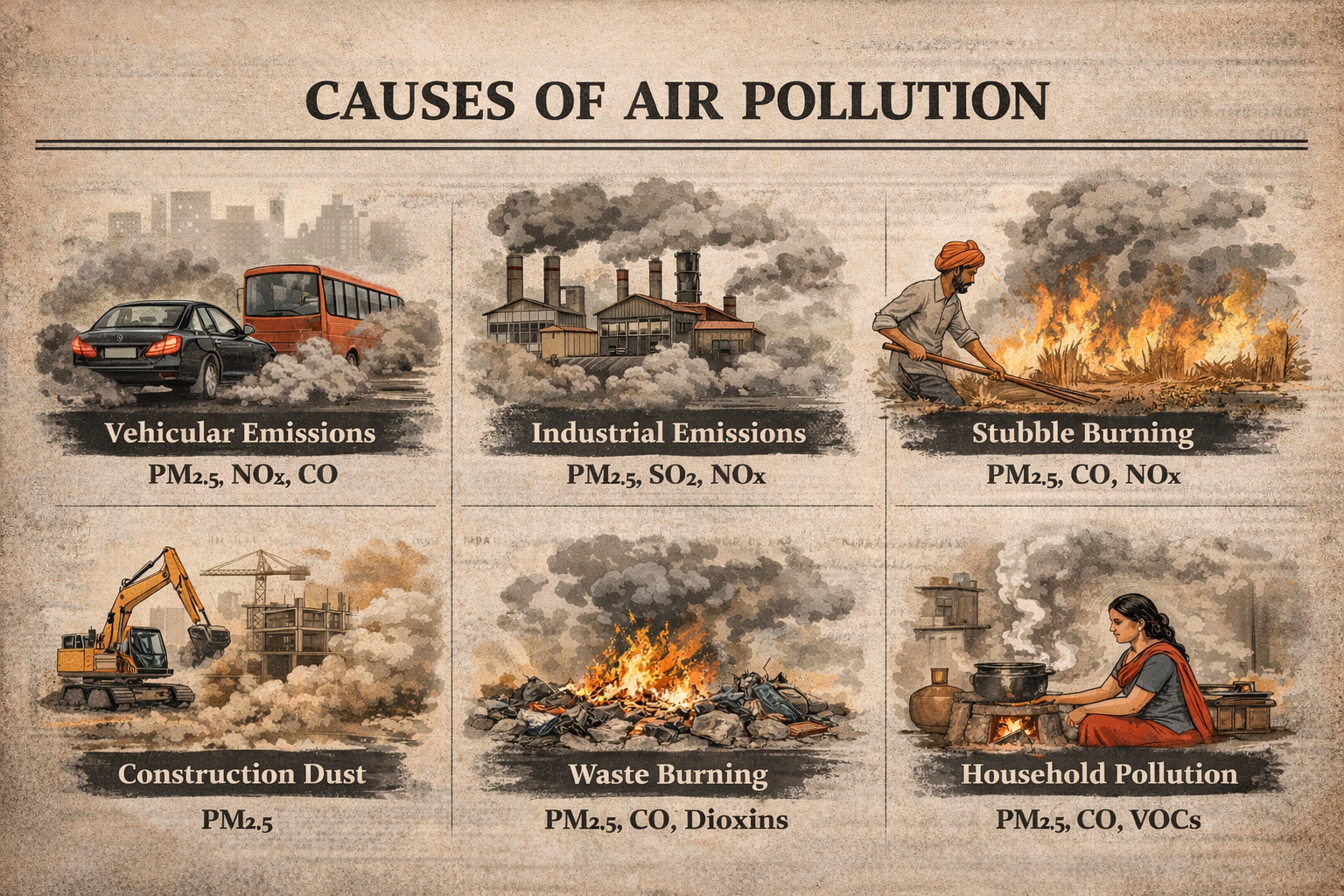
A visual representation of the multifaceted sources contributing to Delhi's air pollution.
1. Stubble Burning: The Seasonal Scourge
Farmers in Punjab and Haryana burn crop residue (stubble) after harvesting paddy to clear fields quickly for the next crop. This practice, while efficient for farmers, creates massive smoke plumes that travel towards Delhi with prevailing winds during late October and November.
2. Vehicular Emissions: An Everyday Culprit
With millions of vehicles on the road, exhaust fumes from cars, buses, and trucks are a constant source of PM2.5, nitrogen oxides, and other harmful pollutants. Older vehicles and poor fuel quality exacerbate the problem.
3. Industrial Pollution: The Silent Killer
Industries in and around the NCR, particularly those using coal and other polluting fuels, release significant amounts of particulate matter and toxic gases into the atmosphere.
4. Construction Dust: A Visible Problem
Rapid infrastructure development in Delhi and NCR leads to a constant generation of dust from construction sites. Poor dust management practices contribute heavily to ambient PM levels.
5. Domestic & Other Sources: Often Overlooked
Burning of biomass for heating and cooking in lower-income areas, open waste burning, and even road dust stirred up by traffic add to the complex mix of pollutants.
Steps Taken and Remedial Measures
Both central and state governments, along with environmental bodies, have implemented several measures, though their effectiveness remains a subject of debate.
Graded Response Action Plan (GRAP): A set of emergency measures (like banning construction, restricting vehicle movement, shutting down power plants) that kick in based on AQI levels.
Odd-Even Scheme: Restricts private vehicles based on their license plate numbers (odd/even) on alternate days to reduce vehicular emissions.
BS-VI Emission Norms: Phased introduction of Bharat Stage VI fuel and vehicles, which are significantly cleaner.
Peripheral Expressways: Construction of Eastern and Western Peripheral Expressways to divert non-destined commercial vehicles away from Delhi.
Smog Towers: Experimental large-scale air purifiers installed in key areas, though their efficacy over a large region is debated.
Subsidies for Crop Residue Management: Efforts to provide farmers with machinery to manage stubble without burning.
Monitoring and Enforcement: Increased surveillance of polluting industries and construction sites.
Green Delhi App: A public grievance platform to report pollution-causing activities.
One of the experimental smog towers in Delhi, part of the broader effort to combat air pollution.
The Human Cost: Impact on Health and Lifestyle
The persistent poor air quality has severe implications for the health of Delhi's 30 million residents.
Respiratory Illnesses: Increased cases of asthma, bronchitis, and Chronic Obstructive Pulmonary Disease (COPD).
Cardiovascular Issues: Exposure to fine particulate matter linked to heart attacks and strokes.
Reduced Lung Function: Particularly in children, leading to lifelong health challenges.
Cancer Risk: Long-term exposure to certain pollutants can increase the risk of lung cancer.
Mental Health: The constant gloom, fear, and restrictions on outdoor activities can impact mental well-being.
Economic Impact: Loss of productivity, increased healthcare costs, and potential impact on tourism and investment.
Voices of Concern: Celebrities Speak Out
The severity of Delhi's pollution crisis has prompted numerous public figures to voice their concerns, bringing much-needed attention to the issue.
"The air quality in Delhi is hazardous. To all my friends and family in Delhi, please be safe. I urge the authorities to take immediate action." - **Priyanka Chopra Jonas** (Actress)
"This is beyond alarming. We need urgent, tangible solutions. Our children deserve to breathe clean air." - **Virat Kohli** (Cricketer)
"Every year, it's the same story. Pollution is not a political issue; it's a human issue. We must come together." - **Arvind Kejriwal** (Chief Minister of Delhi)
Many other prominent personalities, from Bollywood stars to environmental activists, have used their platforms to raise awareness and demand action, often sharing images of the smog-laden skies and urging followers to use masks.
Current Status and The Road Ahead
As of late 2023 / early 2024, Delhi's battle against pollution continues. While there are incremental improvements in monitoring and emergency response, the core systemic issues – stubble burning, vehicular emissions, and industrial pollution – remain formidable challenges.
The long-term solution requires a concerted effort across multiple states and a fundamental shift in agricultural practices, energy sources, and urban planning. Emphasis is being placed on:
Technological Solutions: Cleaner fuels, electric vehicles, and efficient waste management.
Behavioral Changes: Public awareness campaigns, promotion of public transport, and responsible consumption.
Inter-State Cooperation: Collaborative policies to address transboundary pollution like stubble burning.
Green Infrastructure: More green spaces and sustainable urban development.
The fight for clean air is far from over, but with sustained effort, public pressure, and innovative solutions, Delhi can hope to breathe easier in the future.
A hopeful vision of a future Delhi with clean air and lush green spaces.
Mardaani 3 में रानी मुखर्जी मुख्य भूमिका में हैं, जो एक दमदार महिला पुलिस ऑफिसर की भूमिका निभाती हैं जो अपराध-जाल में खुद को चुनौती देती हैं। यह तीसरी कड़ी है Mardaani श्रृंखला की, और इस बार भी कहानी जितनी तेज़, उतनी ही संवेदनशील है।
Vadh 2 एक क्राइम-थ्रिलर है जो न्याय, असफलता और इंसान की मानसिकता के जटिल पहलुओं को उजागर करती है। इस फिल्म में गहरा किरदार विकास और कठिन फैसलों का सामना करता है, जो दर्शकों को अंत तक बांधे रखता है।
O' Romeo एक रोमांटिक-एक्शन फिल्म है जिसमें प्यार और चुनौती दोनों का संगम है। शाहिद कपूर और त्रिप्ती दिमरी की ऑन-स्क्रीन केमिस्ट्री दर्शकों के बीच रोमांच और रोमांस का संतुलन बनाती है।
Dhurandhar एक हाई-वोल्टेज एक्शन फिल्म है जो रोमांच, ड्रामा और गतिशील चरित्रों के साथ दर्शकों को पूरी तरह मनोरंजन देती है। यह साल की चर्चित फिल्म में से एक है।
Rajpal Yadav Surrenders: 2026 Case Progress & Industry Reactions
February 2026 Update: Rajpal Yadav has officially surrendered at Tihar Jail after the Delhi High Court rejected a final mercy plea. The actor expressed deep emotional distress, stating he had "no money left" and felt "alone" in the industry.
A Helping Hand: Celebrity & Public Support
Contrary to Rajpal's emotional statement that "there are no friends" in the industry, several major figures have stepped forward in February 2026 to offer financial and moral support.
Sonu Sood
"He will be part of my next film. A signing amount is not charity, it's dignity. The industry must remind him he’s not alone."
Gurmeet Choudhary
"It breaks my heart to see a senior artist going through this. Our industry is a family, and family does not abandon its own."
Rao Inderjeet Singh
The music producer (GemTunes) has reportedly extended financial assistance worth ₹1.11 crore to help settle the dues.
Tej Pratap Yadav
The JJD Chief announced ₹11 lakh in aid, expressing solidarity with the actor’s grieving family.
Legal Timeline: The Journey to Tihar (2010–2026)
2010: Yadav takes ₹5 crore loan from Murali Projects for his film Ata Pata Laapata.
2018: Convicted for cheque bounce; sentenced to 6 months in jail.
Oct 2025: Court notes that despite paying ₹75 lakh, the bulk of the ₹9 crore debt remains unpaid.
Feb 5, 2026: Following a final extension denial, Rajpal Yadav surrenders at Tihar Jail at 4:00 PM.
Public Reaction
Social media has been flooded with support for the Bhool Bhulaiyaa star. Fans have launched the hashtag #StandWithRajpal, reminding the world of the countless smiles he has brought to Indian cinema. While the legal consensus is that "the law is equal for all," the sentiment remains one of heavy-hearted support for a man who defined comedy for a generation.
“Life is short, and the world is wide.” — a mantra that truly embodied Anunay Sood’s spirit.
Early Life & Background
Anunay Sood was born in 1994 in Delhi, India. :contentReference He completed his schooling at Delhi Public School, Noida, and later graduated from Amity University, Noida, with a degree in Automobile and Automotive Mechanics Technology. :contentReference
Journey into Content Creation
He started his professional life in a corporate marketing role, but his true passion lay in travel and photography. :contentReference Gradually, he began making content — vlogs, photos, cinematic travel reels — capturing lesser-known destinations and offbeat paths.
One of his early breakthrough moments was his Spiti Valley vlog. He tried seven times to reach Spiti, trekking through knee-deep snow in canvas shoes, which resonated deeply with his audience for its raw authenticity. :contentReference
Rise to Fame
Anunay’s unique travel storytelling — blending drone shots, cinematic aesthetics, and personal reflections — helped him gather a massive following. He traveled across more than 46 countries. :contentReference He was featured in prestigious platforms like National Geographic India, CN Traveller India, and Lonely Planet India :contentReference , and was listed in Forbes India’s Top 100 Digital Stars for **three consecutive years** (2022, 2023, 2024). :contentReference
Entrepreneurial Side
Beyond being a content creator, Anunay co-founded Groundwork Solutions, a marketing agency based in Dubai. :contentReference This venture helped him collaborate with big tourism boards and global brands. :contentReference
Personal Life & Relationships
Anunay Sood had a close circle of friends in the creator space. He shared a strong bond with creators like Sourav Joshi and Rida Tharana. :contentReference His partner was Shivani Parihar. :contentReference
Legacy & Impact
He was known for kind-hearted, optimistic storytelling. His videos inspired countless travel lovers to explore the world not just for luxury, but for meaningful experiences. :contentReference
Tragic End
On November 4, 2025, Anunay Sood passed away in Las Vegas at the age of 32. :contentReference His family asked fans for privacy during this difficult time. :contentReference His last Instagram post was from a luxury car event in Las Vegas, where he reflected on being surrounded by “legends and dream machines.” :contentReference
Why He’ll Be Remembered
A pioneer of cinematic travel vlogs. :contentReference
Authentic storytelling — from budget treks to high-end travel. :contentReference
Entrepreneurship — turned a passion into a business. :contentReference
A friend to many creators and a source of inspiration. :contentReference
Conclusion
Anunay Sood’s life was a journey — not just across landscapes, but across dreams. He showed us how genuine passion, coupled with creativity, can create a legacy that outlives oneself. Though his journey ended too soon, his content — full of heart, adventure, and perspective — will continue to inspire future travelers.




 Previous Article

 Posts


