Delhi's Choking Crisis: Unpacking the AQI Disaster, Its Timeline, and The Road Ahead
Delhi's Choking Crisis: Unpacking the AQI Disaster, Its Timeline, and The Road Ahead
Delhi and its surrounding National Capital Region (NCR) face a recurring and severe environmental crisis: alarming levels of air pollution. Every year, as winter approaches, the air quality plummets to hazardous levels, turning the vibrant capital into a gas chamber. This post dives deep into the AQI issues, its causes, impact, and the collective efforts to combat this daunting challenge.

A typical smog-filled morning over Delhi, highlighting the severe air quality issues.
Understanding AQI: What Are We Breathing?
The Air Quality Index (AQI) is a yardstick used to report daily air quality. It tells you how clean or polluted your air is, and what associated health effects might be a concern for you. A higher AQI value indicates a greater level of air pollution and a greater health concern.
- Good (0-50): Air quality is considered satisfactory, and air pollution poses little or no risk.
- Moderate (51-100): Air quality is acceptable; however, for some pollutants, there may be a moderate health concern for a very small number of people who are unusually sensitive to air pollution.
- Unhealthy for Sensitive Groups (101-150): Members of sensitive groups may experience health effects. The general public is less likely to be affected.
- Unhealthy (151-200): Everyone may begin to experience health effects; members of sensitive groups may experience more serious health effects.
- Very Unhealthy (201-300): Health warnings of emergency conditions. The entire population is more likely to be affected.
- Hazardous (301-500+): Health alert: everyone may experience more serious health effects. This is often the category Delhi finds itself in during peak pollution periods.
Key pollutants include Particulate Matter (PM2.5 and PM10), Ozone (O3), Nitrogen Dioxide (NO2), Sulfur Dioxide (SO2), and Carbon Monoxide (CO).
The Genesis of a Crisis: A Timeline of Delhi's Air Pollution Woes
Delhi's air pollution isn't a new phenomenon, but it has escalated dramatically over the past two decades. Here's a simplified timeline of how the issue developed and key moments:
Rising Concerns
Rapid urbanization and industrialization lead to a noticeable increase in smog and respiratory issues. Public awareness slowly begins to build.
The "Gas Chamber" Emerges
Scientific studies and reports increasingly label Delhi as one of the most polluted cities globally. Stubble burning in neighboring states identified as a major seasonal contributor. Diwali firecrackers add to seasonal spikes. Vehicular emissions remain a constant problem.
Emergency Measures & Public Outcry
Implementation of the Graded Response Action Plan (GRAP). Odd-Even scheme piloted. Supreme Court intervenes repeatedly. Public health advisories become common. International media highlights Delhi's plight, prompting global discussion.
The Winter Assault
Combination of stubble burning, festive firecrackers, unfavorable meteorology (calm winds, temperature inversion), and sustained local pollution sources leads to "Hazardous" AQI levels.
Key Contributors to Delhi-NCR's Foul Air
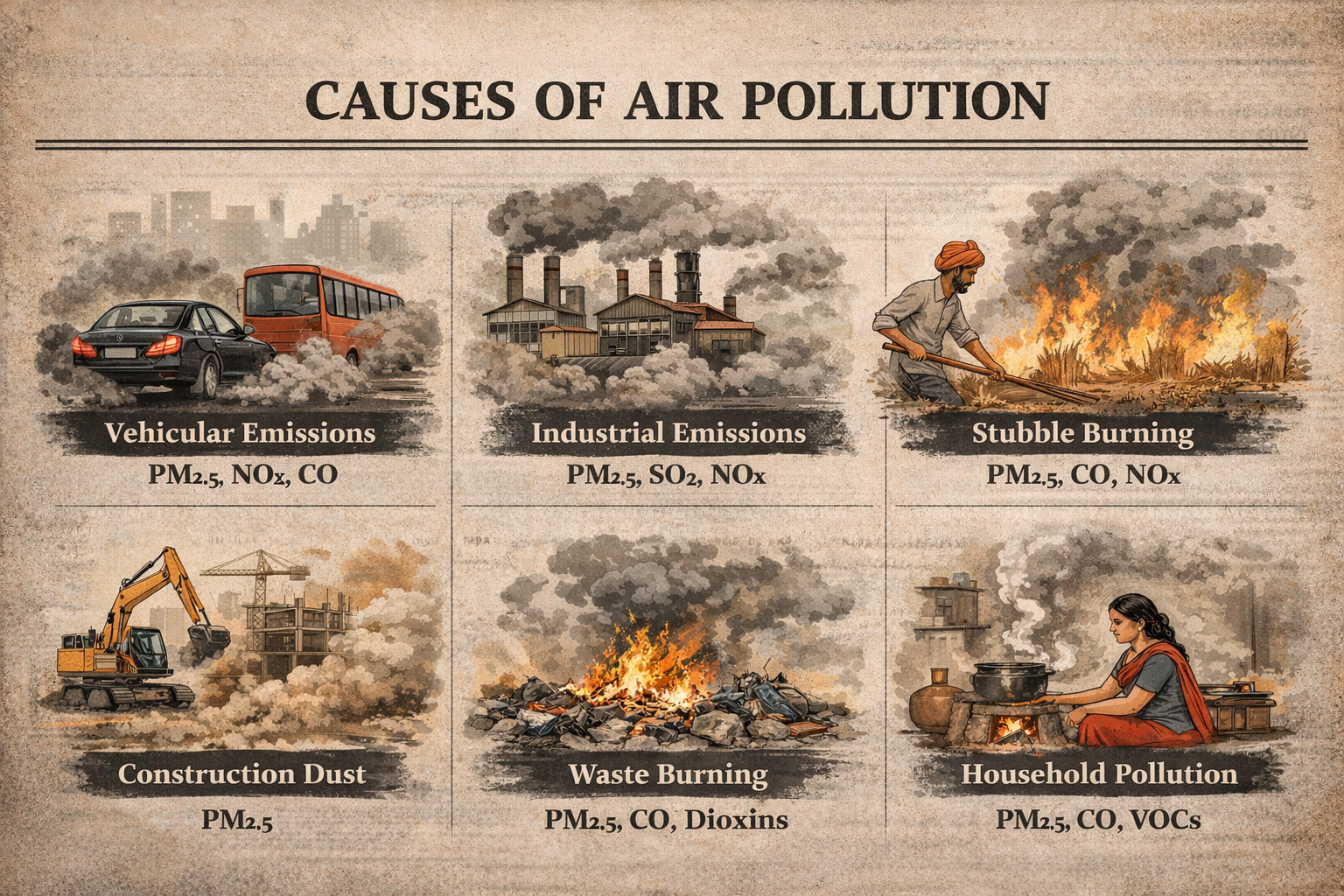
A visual representation of the multifaceted sources contributing to Delhi's air pollution.
1. Stubble Burning: The Seasonal Scourge
Farmers in Punjab and Haryana burn crop residue (stubble) after harvesting paddy to clear fields quickly for the next crop. This practice, while efficient for farmers, creates massive smoke plumes that travel towards Delhi with prevailing winds during late October and November.
2. Vehicular Emissions: An Everyday Culprit
With millions of vehicles on the road, exhaust fumes from cars, buses, and trucks are a constant source of PM2.5, nitrogen oxides, and other harmful pollutants. Older vehicles and poor fuel quality exacerbate the problem.
3. Industrial Pollution: The Silent Killer
Industries in and around the NCR, particularly those using coal and other polluting fuels, release significant amounts of particulate matter and toxic gases into the atmosphere.
4. Construction Dust: A Visible Problem
Rapid infrastructure development in Delhi and NCR leads to a constant generation of dust from construction sites. Poor dust management practices contribute heavily to ambient PM levels.
5. Domestic & Other Sources: Often Overlooked
Burning of biomass for heating and cooking in lower-income areas, open waste burning, and even road dust stirred up by traffic add to the complex mix of pollutants.
Steps Taken and Remedial Measures
Both central and state governments, along with environmental bodies, have implemented several measures, though their effectiveness remains a subject of debate.
- Graded Response Action Plan (GRAP): A set of emergency measures (like banning construction, restricting vehicle movement, shutting down power plants) that kick in based on AQI levels.
- Odd-Even Scheme: Restricts private vehicles based on their license plate numbers (odd/even) on alternate days to reduce vehicular emissions.
- BS-VI Emission Norms: Phased introduction of Bharat Stage VI fuel and vehicles, which are significantly cleaner.
- Peripheral Expressways: Construction of Eastern and Western Peripheral Expressways to divert non-destined commercial vehicles away from Delhi.
- Smog Towers: Experimental large-scale air purifiers installed in key areas, though their efficacy over a large region is debated.
- Subsidies for Crop Residue Management: Efforts to provide farmers with machinery to manage stubble without burning.
- Monitoring and Enforcement: Increased surveillance of polluting industries and construction sites.
- Green Delhi App: A public grievance platform to report pollution-causing activities.

One of the experimental smog towers in Delhi, part of the broader effort to combat air pollution.
The Human Cost: Impact on Health and Lifestyle
The persistent poor air quality has severe implications for the health of Delhi's 30 million residents.
- Respiratory Illnesses: Increased cases of asthma, bronchitis, and Chronic Obstructive Pulmonary Disease (COPD).
- Cardiovascular Issues: Exposure to fine particulate matter linked to heart attacks and strokes.
- Reduced Lung Function: Particularly in children, leading to lifelong health challenges.
- Cancer Risk: Long-term exposure to certain pollutants can increase the risk of lung cancer.
- Mental Health: The constant gloom, fear, and restrictions on outdoor activities can impact mental well-being.
- Economic Impact: Loss of productivity, increased healthcare costs, and potential impact on tourism and investment.
Voices of Concern: Celebrities Speak Out
The severity of Delhi's pollution crisis has prompted numerous public figures to voice their concerns, bringing much-needed attention to the issue.
"The air quality in Delhi is hazardous. To all my friends and family in Delhi, please be safe. I urge the authorities to take immediate action." - **Priyanka Chopra Jonas** (Actress)
"This is beyond alarming. We need urgent, tangible solutions. Our children deserve to breathe clean air." - **Virat Kohli** (Cricketer)
"Every year, it's the same story. Pollution is not a political issue; it's a human issue. We must come together." - **Arvind Kejriwal** (Chief Minister of Delhi)
Many other prominent personalities, from Bollywood stars to environmental activists, have used their platforms to raise awareness and demand action, often sharing images of the smog-laden skies and urging followers to use masks.
Current Status and The Road Ahead
As of late 2023 / early 2024, Delhi's battle against pollution continues. While there are incremental improvements in monitoring and emergency response, the core systemic issues – stubble burning, vehicular emissions, and industrial pollution – remain formidable challenges.
The long-term solution requires a concerted effort across multiple states and a fundamental shift in agricultural practices, energy sources, and urban planning. Emphasis is being placed on:
- Technological Solutions: Cleaner fuels, electric vehicles, and efficient waste management.
- Behavioral Changes: Public awareness campaigns, promotion of public transport, and responsible consumption.
- Inter-State Cooperation: Collaborative policies to address transboundary pollution like stubble burning.
- Green Infrastructure: More green spaces and sustainable urban development.
The fight for clean air is far from over, but with sustained effort, public pressure, and innovative solutions, Delhi can hope to breathe easier in the future.

A hopeful vision of a future Delhi with clean air and lush green spaces.
Tags: Environment, Health, society

 Previous Article
 Posts
Posts


Share your views...
0 Respones to "Delhi's Choking Crisis: Unpacking the AQI Disaster, Its Timeline, and The Road Ahead"
Post a Comment