Python for Artificial Intelligence: Complete Practical Guide with Real Examples
Python for Artificial Intelligence
Introduction
Python is the most widely used programming language for Artificial Intelligence due to its simplicity, strong community support and powerful libraries.
Why Python for AI
Simple syntax
Large ecosystem of AI libraries
Strong community
Rapid prototyping
Important Python Libraries for AI
NumPy
Used for numerical computations and matrix operations.
Pandas
Used for data manipulation and preprocessing.
Matplotlib
Used for visualization.
Scikit Learn
Used for machine learning algorithms.
TensorFlow and PyTorch
Used for deep learning and neural networks.
Basic AI Workflow in Python
Import Libraries Load Data Preprocess Data Train Model Evaluate Model Make Predictions
Example: Simple Linear Regression
import numpy as np from sklearn.linear_model import LinearRegression X = np.array([[1], [2], [3], [4]]) y = np.array([2, 4, 6, 8]) model = LinearRegression() model.fit(X, y) prediction = model.predict([[5]]) print(prediction)
Real Life Use Case
Retail companies use Python ML models to forecast product demand based on historical sales data.
Common Mistakes
Not cleaning data properly
Ignoring train test split
Overfitting the model
Interview Questions with Answers
Why is Python preferred for AI? Answer: Python has simple syntax, powerful libraries like NumPy and TensorFlow, strong community support and fast development speed.
What is NumPy used for? Answer: NumPy is used for numerical computations and matrix operations.
What is train test split? Answer: It divides data into training and testing sets to evaluate model performance on unseen data.
Certification Practice Questions with Answers
Which library is commonly used for machine learning in Python? Answer: Scikit Learn.
Which library is used for deep learning? Answer: TensorFlow or PyTorch.
Why is data preprocessing important? Answer: It improves model accuracy and prevents misleading results.
Summary
Python provides the tools and ecosystem needed to build AI systems efficiently and effectively.
Mathematics for Artificial Intelligence: The Complete Practical Guide for Professionals
Mathematics for Artificial Intelligence
Introduction
Mathematics forms the backbone of Artificial Intelligence. While libraries simplify implementation, understanding the math improves model design and debugging skills.
1. Linear Algebra
Vectors
Vectors represent data points. For example, a house price prediction model may represent a house as:
[Size, Bedrooms, Age]
Matrices
Matrices store datasets where rows represent examples and columns represent features.
Matrix Multiplication
Used in neural networks to compute weighted sums.
2. Calculus
Derivatives
Derivatives measure rate of change and are used in gradient descent optimization.
Gradient Descent
An optimization algorithm used to minimize error in models.
3. Probability
Conditional Probability
Used in spam detection and Bayesian classifiers.
Bayes Theorem
Helps update probability based on new evidence.
4. Statistics
Mean and Variance
Measure central tendency and data spread.
Normal Distribution
Many natural phenomena follow a bell curve distribution.
Real Life Example
In fraud detection:
Linear algebra processes transaction features.
Probability estimates fraud likelihood.
Calculus optimizes model accuracy.
Common Mistakes
Ignoring feature scaling.
Not understanding gradient descent convergence.
Confusing correlation with causation.
Interview Questions
Why is linear algebra important in AI?
Explain gradient descent.
What is conditional probability?
Certification Practice Questions
What does a derivative represent?
What is the role of matrices in ML?
State Bayes Theorem.
Summary
Linear algebra structures data, calculus optimizes models, probability manages uncertainty, and statistics interprets results.
Artificial Intelligence vs Machine Learning vs Deep Learning: Complete Professional Comparison
Artificial Intelligence vs Machine Learning vs Deep Learning
Introduction
Many professionals use AI, Machine Learning and Deep Learning interchangeably. However, they are related but not identical. Understanding the differences is essential for interviews, certifications and real world implementation.
What is Artificial Intelligence
Artificial Intelligence is the broad field focused on building intelligent systems that can simulate human intelligence.
What is Machine Learning
Machine Learning is a subset of AI that enables systems to learn patterns from data instead of being explicitly programmed.
What is Deep Learning
Deep Learning is a subset of Machine Learning that uses neural networks with multiple layers to process complex data such as images, speech and text.
Relationship Diagram
Artificial Intelligence └── Machine Learning └── Deep Learning
Key Differences
Aspect
AI
Machine Learning
Deep Learning
Scope
Broad field
Subset of AI
Subset of ML
Data Dependency
May use rules
Requires data
Requires large data
Examples
Expert systems
Spam detection
Image recognition
Real Life Example
Consider a self driving car:
AI is the overall system making driving decisions.
Machine Learning detects patterns in traffic data.
Deep Learning processes camera images to recognize pedestrians.
When to Use What
Use AI for rule based automation.
Use ML for predictive modeling.
Use DL for complex unstructured data like images or audio.
Common Mistakes
Assuming all AI uses neural networks.
Ignoring data quality in ML projects.
Using deep learning without sufficient data.
Interview Questions
Explain AI, ML and DL with real world example.
Is Deep Learning always better than Machine Learning?
Why is ML considered data driven?
Certification Practice Questions
Which is a subset of Machine Learning?
Does AI always require data?
Which technique is best for image classification?
Summary
Artificial Intelligence is the umbrella field. Machine Learning enables learning from data. Deep Learning uses layered neural networks for complex pattern recognition.
SEO Tags: AI vs ML vs DL, difference between artificial intelligence and machine learning, deep learning basics, AI concepts, machine learning tutorial
Types of Artificial Intelligence: Narrow AI, General AI and Super AI Explained
Types of Artificial Intelligence
Introduction
Artificial Intelligence can be classified into different types based on capability and functionality. Understanding these types helps professionals evaluate current AI systems and future possibilities.
Type 1: Narrow AI
Narrow AI, also called Weak AI, is designed to perform a single task efficiently. It cannot operate beyond its defined domain.
Examples
Email spam filters
Voice assistants
Recommendation systems
Face recognition systems
Real Life Use Case
E-commerce platforms use recommendation engines to suggest products based on user browsing behavior.
Type 2: General AI
General AI refers to systems capable of performing any intellectual task a human can do. This type does not currently exist but is a major research goal.
Type 3: Super AI
Super AI would surpass human intelligence in all aspects including creativity, emotional intelligence and problem solving. It remains theoretical.
Functional Classification
Reactive Machines
AI systems that respond to current input without memory of past events.
Limited Memory AI
Systems that use historical data for decision making. Most modern AI systems fall in this category.
Theory of Mind AI
Hypothetical systems that understand emotions and social interactions.
Self Aware AI
Fully conscious AI systems, currently theoretical.
Comparison Table
Narrow AI → Task specific General AI → Human level intelligence Super AI → Beyond human intelligence
Interview Questions
What is Narrow AI with example?
Is General AI currently available?
Differentiate capability based and functionality based classification.
Certification Practice Questions
Which type of AI is currently dominant?
Explain Limited Memory AI with example.
What makes Super AI theoretical?
Summary
Most AI systems today are Narrow AI. General and Super AI remain future possibilities. Understanding classifications helps professionals align expectations with reality.
History and Evolution of Artificial Intelligence: From Theory to Modern Breakthroughs
History and Evolution of Artificial Intelligence
Introduction
Artificial Intelligence did not appear overnight. It evolved through decades of research, experimentation, failures, and breakthroughs. Understanding the history of AI helps professionals understand where the technology is heading.
Early Foundations (1940s to 1950s)
Theoretical Roots
The concept of intelligent machines began with mathematical logic and computing theory. Alan Turing introduced the idea that machines could simulate human reasoning.
The Turing Test
Proposed in 1950, the Turing Test evaluates whether a machine can imitate human conversation well enough to be indistinguishable from a human.
The Birth of AI (1956)
The term Artificial Intelligence was formally introduced at the Dartmouth Conference in 1956. Researchers believed machines would soon match human intelligence. This period marked the official start of AI as a scientific discipline.
The First AI Programs
Logic Theorist
Early Chess Playing Programs
Symbolic Reasoning Systems
AI Winter (1970s to 1980s)
Expectations exceeded capabilities. Funding was reduced due to slow progress and technical limitations. This period is known as the AI Winter.
Expert Systems Era
In the 1980s, AI gained traction through rule based expert systems used in medical diagnosis and business decision support.
Machine Learning Revolution (1990s to 2010)
Instead of hard coding rules, systems began learning from data. Statistical models and algorithms improved pattern recognition and prediction accuracy.
Deep Learning Breakthrough (2012 onwards)
With increased computing power and big data, neural networks became powerful. Image recognition and speech processing accuracy improved dramatically.
Modern AI Era
Self driving cars
Large language models
AI powered recommendation engines
Medical image diagnostics
AI Timeline Summary
1940s: Theoretical foundations 1956: AI term introduced 1970s: AI Winter 1980s: Expert systems 1990s: Machine learning growth 2012: Deep learning revolution 2020s: Generative AI expansion
Real Life Use Case Example
Bank fraud detection evolved from rule based systems to machine learning models that continuously adapt to new fraud patterns.
Interview Questions
What was the significance of the Dartmouth Conference?
Explain AI Winter.
What changed during the machine learning revolution?
Why was deep learning successful after 2012?
Certification Practice Questions
Which period is known as AI Winter?
Who proposed the Turing Test?
What technological factors enabled deep learning success?
Summary
AI evolved from symbolic reasoning to data driven intelligence. Advances in computing power and data availability accelerated its growth into modern applications.
What is Artificial Intelligence: A Complete Beginner to Professional Guide
What is Artificial Intelligence: A Complete Beginner to Professional Guide
Introduction
Artificial Intelligence, commonly known as AI, refers to the ability of machines to simulate human intelligence. It enables systems to learn from data, make decisions, recognize patterns, and solve problems.
Definition of Artificial Intelligence
Artificial Intelligence is a branch of computer science focused on building systems that can perform tasks that normally require human intelligence. These tasks include reasoning, learning, planning, perception, and language understanding.
Core Characteristics of AI
Learning from data
Pattern recognition
Decision making
Problem solving
Adaptation
Types of Artificial Intelligence
1. Narrow AI
Designed to perform one specific task. Example: voice assistants, spam filters.
2. General AI
Hypothetical AI that can perform any intellectual task a human can do.
3. Super AI
Theoretical AI surpassing human intelligence.
Real Life Examples
Netflix recommending movies
Google Maps predicting traffic
Chatbots answering customer support
Fraud detection in banks
How AI Works
AI systems follow this simplified process:
Data → Training → Model → Prediction → Improvement
Applications of AI
Healthcare diagnosis
Autonomous vehicles
Financial risk prediction
Retail demand forecasting
Cybersecurity threat detection
Common Misconceptions
AI is not magic
AI does not think like humans
AI needs high quality data
Interview Questions
What is Artificial Intelligence?
Difference between AI and Machine Learning?
Explain Narrow AI with example.
What are real world applications of AI?
Certification Practice Questions
Which of the following is an example of Narrow AI?
What is the primary goal of AI systems?
Why is data important in AI?
Summary
Artificial Intelligence enables machines to perform intelligent tasks using data and algorithms. It is transforming industries across the world.
SEO Tags: artificial intelligence tutorial, what is AI, AI for beginners, AI explained, AI course, machine learning basics, AI interview questions, AI certification preparation
Mohammad Deepak: From Civic Hero to Target of a ₹2 Lakh Bounty and a Feb 12 "Lesson"
LATEST PROGRESS: Feb 11, 2026
A new wave of tension has gripped Kotdwar. The Hindu Raksha Dal, led by state chief Lalit Sharma, has officially called for a massive gathering of "Sanatanis" outside Deepak's gym on February 12, 2026. In a viral video, Sharma labeled Deepak a "secular bug" and vowed to "teach him a lesson." Local police have intensified security and issued a stern warning against any breach of peace.
Summary of the Controversy
Deepak Kumar Kashyap, a 46-year-old gym owner in Kotdwar, Uttarakhand, became a national sensation on Republic Day 2026. He intervened when a group of Bajrang Dal activists harassed a 70-year-old Muslim shopkeeper, Vakeel Ahmed, who suffers from Parkinson's, demanding he rename his shop 'Baba School Dress.' When the mob questioned Deepak's identity, he famously replied, "Mera naam Mohammad Deepak hai," as a gesture of communal unity. Since then, he has faced a severe social boycott, legal FIRs, and physical threats.
Complete Case Timeline
January 26, 2026
Deepak intervenes at Patel Marg. The video of him protecting Vakeel Ahmed and calling himself "Mohammad Deepak" goes viral.
January 31, 2026
Right-wing mobs gather outside Deepak’s Hulk Gym. Roads are blocked, and police are forced to escort Deepak to the station for his own safety.
February 2, 2026
Three FIRs are filed. One against the mob, one by Vakeel Ahmed, and—controversially—one against Deepak and his friend Vijay Rawat for "criminal intimidation" based on a counter-complaint.
February 9, 2026
Police track down Utkarsh Kumar Singh from Bihar, who offered a ₹2 lakh bounty on Deepak's life on social media. Singh claimed it was a stunt to gain followers.
February 11, 2026
Hindu Raksha Dal mobilizes for a February 12 protest. Deepak reports that gym membership has crashed from 150 to nearly 12, and his daughter is afraid to attend school.
Reactions: Support vs. Threats
Rahul Gandhi (LoP):
"Deepak is a living symbol of a 'Shop of Love' in a 'Market of Hate.' He is a lion-hearted warrior for the Constitution."
CPI(M) MP John Brittas:
Brittas visited Kotdwar, took a one-year membership at Hulk Gym, and called Deepak the "diamond-bright light of hope" for India.
Hindu Raksha Dal (Lalit Sharma):
Issued a public call for "all Sanatanis" to march to Kotdwar on Feb 12 to "teach Deepak a lesson" for his secular stand.
Economic Boycott:
Locals describe the gym as "covered in darkness" as regular members stay away to avoid police questioning or being targeted by right-wing outfits.
Verified References
Hindustan Times:"‘Secular bug’: Hindu Raksha Dal threatens ‘Mohd’ Deepak, calls Feb 12 protest" (Published Feb 10, 2026).
Times of India:"Bihar man detained over threat video against Deepak Kumar" (Published Feb 10, 2026).
The Hindu:"Mohammed Deepak gets wave of support after gym membership decline" (Feb 10, 2026).
National Herald:"Mohd Deepak’s heroism comes at a cost" (Feb 8, 2026).
Legal Notice: This post is a transformative news commentary. All information is sourced from public records and verified media reports. It is published under the 'Fair Use' doctrine for educational and informational purposes.
Sha’Carri Richardson Arrested in Florida: Speeding Case & Legal Timeline
LATEST UPDATE: As of February 2026, Sha’Carri Richardson and partner Christian Coleman have officially entered not guilty pleas following their January arrest in Orange County, Florida.
World-renowned sprinter and Olympic gold medalist Sha’Carri Richardson is facing legal scrutiny once again. Following a high-speed traffic stop in Florida, the track star has become the center of a national conversation regarding athlete conduct and police interaction.
The January 2026 Incident
On January 29, 2026, Florida Highway Patrol clocked a gray Aston Martin traveling at 104 mph in a 65 mph zone on State Road 429. The driver was identified as Richardson. According to the arrest affidavit, she was observed weaving through traffic and tailgating other motorists. Bodycam footage released in February shows an emotional Richardson pleading with officers, citing a "low tire pressure" issue as the reason for her erratic driving—a claim the arresting officer dismissed as she was traveling nearly 40 mph over the limit.
Complete Case Timeline
July 2025Seattle Airport Arrest: Richardson was arrested for 4th-degree domestic assault following a physical dispute with Christian Coleman at a TSA checkpoint. No charges were pressed by Coleman.
August 2025Public Apology: Richardson issued a statement vowing to seek "self-reflection" and "help" to handle her emotions more effectively.
January 29, 2026Florida Arrest: Charged with "Dangerous Excessive Speeding." Bond was set at $500. Christian Coleman was also arrested at the scene for resisting an officer and possession of drug paraphernalia.
February 4-5, 2026Not Guilty Plea: Through attorney Alisia Adamson, Richardson and Coleman officially pleaded not guilty to all charges in Orange County court.
Public & Celebrity Reactions
"She’s a human being and a great person. She has a lot of things going on, emotions that nobody can understand. She's one of one."
— Christian Coleman (Fellow Sprinter)
"The release of the bodycam footage feels like public humiliation. She was already facing charges; the state did not need to further humiliate an icon."
— Social Media Commentary (#LetShacarriRun)
While some fans have been critical of her "repeat offender" status, many in the track community—including teammates like Twanisha Terry (who was present at the stop)—have shown solidarity, questioning the aggressive tone used by officers in the released video.
References & News Sources
WFAA News:"Affidavit, bodycam video give details of Richardson's arrest" (Feb 2026).
The Times of India:"Sha’Carri Richardson and Christian Coleman enter not guilty pleas" (Feb 5, 2026).
The Guardian:"Sha'Carri Richardson vows to seek help after 2025 incident" (Archive).
Legal Disclaimer & Fair Use: This post serves as a transformative news summary and commentary. All facts are based on public court records and verified journalistic reports. No copyrighted images or videos from the original sources have been reproduced here without permission.
Why I Unfollowed 500 People to Save the Planet (and My Sanity)
In early 2026, I realized my smartphone wasn't just a communication tool—it was a personal exhaust pipe. Every like, every auto-play video, and every unread newsletter sitting in my inbox was contributing to a massive, invisible infrastructure of data centers that consume as much electricity as small nations.
The Hook: We talk about plastic straws and electric cars, but we rarely talk about our "Digital Carbon Footprint." I decided to delete 500 followers and 20 apps. Here is what happened.
1. The Invisible Cost of a "Follow"
Every time you follow an account, you trigger a chain reaction. Algorithms must now process more data to show you their content, and those videos are stored on high-powered servers. By unfollowing 500 inactive or "noise" accounts, I reduced the constant data requests sent to my device.
4g CO2Per Email Sent
102kg CO2Avg. Annual Smartphone Impact
2. Reclaiming Mental Sovereignty
Digital minimalism isn't just about the planet; it's about your peace. Without 500 voices shouting for my attention, I regained nearly 2 hours of my day. I stopped "doom-scrolling" and started "deep-working."
3. Your 3-Step Digital Declutter Checklist
Audit Your Feed: If an account doesn't inspire or inform you, unfollow. Don't let "polite following" drain your energy.
The Email Purge: Use tools like Unroll.me or manual unsubscribing. Deleting 1,000 unread emails saves roughly 32kg of CO2 over a year.
Greyscale Mode: Turn your phone to black and white. It makes the "attention-grabbing" icons look boring, instantly reducing screen time.
The Result?
My focus has never been sharper. By choosing intentionality over infinity, I've created a digital life that serves me, rather than me serving it. The planet—and my brain—thanked me.
Delhi's Choking Crisis: Unpacking the AQI Disaster, Its Timeline, and The Road Ahead
Delhi's Choking Crisis: Unpacking the AQI Disaster, Its Timeline, and The Road Ahead
Delhi and its surrounding National Capital Region (NCR) face a recurring and severe environmental crisis: alarming levels of air pollution. Every year, as winter approaches, the air quality plummets to hazardous levels, turning the vibrant capital into a gas chamber. This post dives deep into the AQI issues, its causes, impact, and the collective efforts to combat this daunting challenge.
A typical smog-filled morning over Delhi, highlighting the severe air quality issues.
Understanding AQI: What Are We Breathing?
The Air Quality Index (AQI) is a yardstick used to report daily air quality. It tells you how clean or polluted your air is, and what associated health effects might be a concern for you. A higher AQI value indicates a greater level of air pollution and a greater health concern.
Good (0-50): Air quality is considered satisfactory, and air pollution poses little or no risk.
Moderate (51-100): Air quality is acceptable; however, for some pollutants, there may be a moderate health concern for a very small number of people who are unusually sensitive to air pollution.
Unhealthy for Sensitive Groups (101-150): Members of sensitive groups may experience health effects. The general public is less likely to be affected.
Unhealthy (151-200): Everyone may begin to experience health effects; members of sensitive groups may experience more serious health effects.
Very Unhealthy (201-300): Health warnings of emergency conditions. The entire population is more likely to be affected.
Hazardous (301-500+): Health alert: everyone may experience more serious health effects. This is often the category Delhi finds itself in during peak pollution periods.
Key pollutants include Particulate Matter (PM2.5 and PM10), Ozone (O3), Nitrogen Dioxide (NO2), Sulfur Dioxide (SO2), and Carbon Monoxide (CO).
The Genesis of a Crisis: A Timeline of Delhi's Air Pollution Woes
Delhi's air pollution isn't a new phenomenon, but it has escalated dramatically over the past two decades. Here's a simplified timeline of how the issue developed and key moments:
Early 2000s
Rising Concerns
Rapid urbanization and industrialization lead to a noticeable increase in smog and respiratory issues. Public awareness slowly begins to build.
2010-2015
The "Gas Chamber" Emerges
Scientific studies and reports increasingly label Delhi as one of the most polluted cities globally. Stubble burning in neighboring states identified as a major seasonal contributor. Diwali firecrackers add to seasonal spikes. Vehicular emissions remain a constant problem.
2016-Present
Emergency Measures & Public Outcry
Implementation of the Graded Response Action Plan (GRAP). Odd-Even scheme piloted. Supreme Court intervenes repeatedly. Public health advisories become common. International media highlights Delhi's plight, prompting global discussion.
Annually, October-November
The Winter Assault
Combination of stubble burning, festive firecrackers, unfavorable meteorology (calm winds, temperature inversion), and sustained local pollution sources leads to "Hazardous" AQI levels.
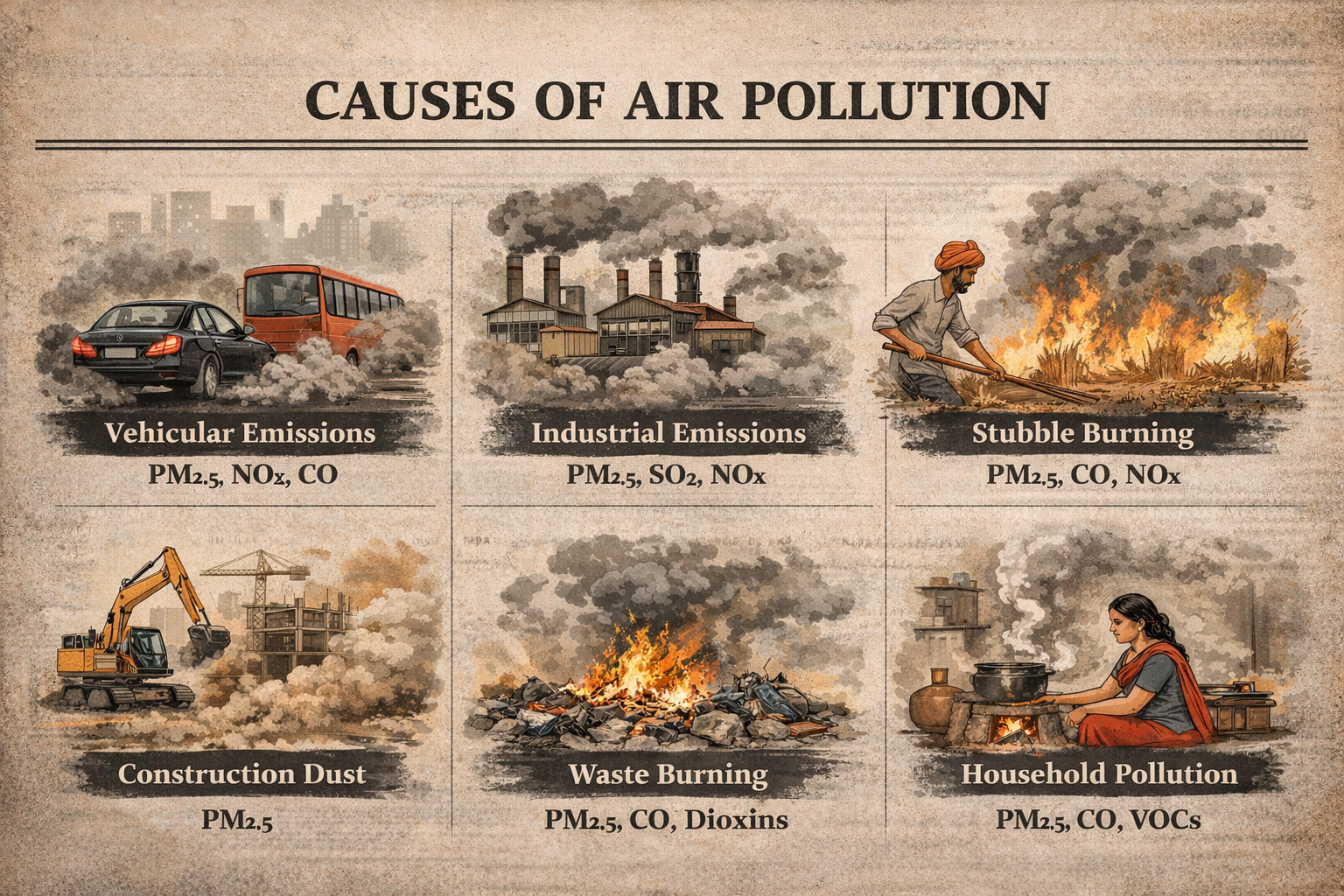
Key Contributors to Delhi-NCR's Foul Air
A visual representation of the multifaceted sources contributing to Delhi's air pollution.
1. Stubble Burning: The Seasonal Scourge
Farmers in Punjab and Haryana burn crop residue (stubble) after harvesting paddy to clear fields quickly for the next crop. This practice, while efficient for farmers, creates massive smoke plumes that travel towards Delhi with prevailing winds during late October and November.
2. Vehicular Emissions: An Everyday Culprit
With millions of vehicles on the road, exhaust fumes from cars, buses, and trucks are a constant source of PM2.5, nitrogen oxides, and other harmful pollutants. Older vehicles and poor fuel quality exacerbate the problem.
3. Industrial Pollution: The Silent Killer
Industries in and around the NCR, particularly those using coal and other polluting fuels, release significant amounts of particulate matter and toxic gases into the atmosphere.
4. Construction Dust: A Visible Problem
Rapid infrastructure development in Delhi and NCR leads to a constant generation of dust from construction sites. Poor dust management practices contribute heavily to ambient PM levels.
5. Domestic & Other Sources: Often Overlooked
Burning of biomass for heating and cooking in lower-income areas, open waste burning, and even road dust stirred up by traffic add to the complex mix of pollutants.
Steps Taken and Remedial Measures
Both central and state governments, along with environmental bodies, have implemented several measures, though their effectiveness remains a subject of debate.
Graded Response Action Plan (GRAP): A set of emergency measures (like banning construction, restricting vehicle movement, shutting down power plants) that kick in based on AQI levels.
Odd-Even Scheme: Restricts private vehicles based on their license plate numbers (odd/even) on alternate days to reduce vehicular emissions.
BS-VI Emission Norms: Phased introduction of Bharat Stage VI fuel and vehicles, which are significantly cleaner.
Peripheral Expressways: Construction of Eastern and Western Peripheral Expressways to divert non-destined commercial vehicles away from Delhi.
Smog Towers: Experimental large-scale air purifiers installed in key areas, though their efficacy over a large region is debated.
Subsidies for Crop Residue Management: Efforts to provide farmers with machinery to manage stubble without burning.
Monitoring and Enforcement: Increased surveillance of polluting industries and construction sites.
Green Delhi App: A public grievance platform to report pollution-causing activities.
One of the experimental smog towers in Delhi, part of the broader effort to combat air pollution.
The Human Cost: Impact on Health and Lifestyle
The persistent poor air quality has severe implications for the health of Delhi's 30 million residents.
Respiratory Illnesses: Increased cases of asthma, bronchitis, and Chronic Obstructive Pulmonary Disease (COPD).
Cardiovascular Issues: Exposure to fine particulate matter linked to heart attacks and strokes.
Reduced Lung Function: Particularly in children, leading to lifelong health challenges.
Cancer Risk: Long-term exposure to certain pollutants can increase the risk of lung cancer.
Mental Health: The constant gloom, fear, and restrictions on outdoor activities can impact mental well-being.
Economic Impact: Loss of productivity, increased healthcare costs, and potential impact on tourism and investment.
Voices of Concern: Celebrities Speak Out
The severity of Delhi's pollution crisis has prompted numerous public figures to voice their concerns, bringing much-needed attention to the issue.
"The air quality in Delhi is hazardous. To all my friends and family in Delhi, please be safe. I urge the authorities to take immediate action." - **Priyanka Chopra Jonas** (Actress)
"This is beyond alarming. We need urgent, tangible solutions. Our children deserve to breathe clean air." - **Virat Kohli** (Cricketer)
"Every year, it's the same story. Pollution is not a political issue; it's a human issue. We must come together." - **Arvind Kejriwal** (Chief Minister of Delhi)
Many other prominent personalities, from Bollywood stars to environmental activists, have used their platforms to raise awareness and demand action, often sharing images of the smog-laden skies and urging followers to use masks.
Current Status and The Road Ahead
As of late 2023 / early 2024, Delhi's battle against pollution continues. While there are incremental improvements in monitoring and emergency response, the core systemic issues – stubble burning, vehicular emissions, and industrial pollution – remain formidable challenges.
The long-term solution requires a concerted effort across multiple states and a fundamental shift in agricultural practices, energy sources, and urban planning. Emphasis is being placed on:
Technological Solutions: Cleaner fuels, electric vehicles, and efficient waste management.
Behavioral Changes: Public awareness campaigns, promotion of public transport, and responsible consumption.
Inter-State Cooperation: Collaborative policies to address transboundary pollution like stubble burning.
Green Infrastructure: More green spaces and sustainable urban development.
The fight for clean air is far from over, but with sustained effort, public pressure, and innovative solutions, Delhi can hope to breathe easier in the future.
A hopeful vision of a future Delhi with clean air and lush green spaces.
Mardaani 3 में रानी मुखर्जी मुख्य भूमिका में हैं, जो एक दमदार महिला पुलिस ऑफिसर की भूमिका निभाती हैं जो अपराध-जाल में खुद को चुनौती देती हैं। यह तीसरी कड़ी है Mardaani श्रृंखला की, और इस बार भी कहानी जितनी तेज़, उतनी ही संवेदनशील है।
Vadh 2 एक क्राइम-थ्रिलर है जो न्याय, असफलता और इंसान की मानसिकता के जटिल पहलुओं को उजागर करती है। इस फिल्म में गहरा किरदार विकास और कठिन फैसलों का सामना करता है, जो दर्शकों को अंत तक बांधे रखता है।
O' Romeo एक रोमांटिक-एक्शन फिल्म है जिसमें प्यार और चुनौती दोनों का संगम है। शाहिद कपूर और त्रिप्ती दिमरी की ऑन-स्क्रीन केमिस्ट्री दर्शकों के बीच रोमांच और रोमांस का संतुलन बनाती है।
Dhurandhar एक हाई-वोल्टेज एक्शन फिल्म है जो रोमांच, ड्रामा और गतिशील चरित्रों के साथ दर्शकों को पूरी तरह मनोरंजन देती है। यह साल की चर्चित फिल्म में से एक है।
Rajpal Yadav Surrenders: 2026 Case Progress & Industry Reactions
February 2026 Update: Rajpal Yadav has officially surrendered at Tihar Jail after the Delhi High Court rejected a final mercy plea. The actor expressed deep emotional distress, stating he had "no money left" and felt "alone" in the industry.
A Helping Hand: Celebrity & Public Support
Contrary to Rajpal's emotional statement that "there are no friends" in the industry, several major figures have stepped forward in February 2026 to offer financial and moral support.
Sonu Sood
"He will be part of my next film. A signing amount is not charity, it's dignity. The industry must remind him he’s not alone."
Gurmeet Choudhary
"It breaks my heart to see a senior artist going through this. Our industry is a family, and family does not abandon its own."
Rao Inderjeet Singh
The music producer (GemTunes) has reportedly extended financial assistance worth ₹1.11 crore to help settle the dues.
Tej Pratap Yadav
The JJD Chief announced ₹11 lakh in aid, expressing solidarity with the actor’s grieving family.
Legal Timeline: The Journey to Tihar (2010–2026)
2010: Yadav takes ₹5 crore loan from Murali Projects for his film Ata Pata Laapata.
2018: Convicted for cheque bounce; sentenced to 6 months in jail.
Oct 2025: Court notes that despite paying ₹75 lakh, the bulk of the ₹9 crore debt remains unpaid.
Feb 5, 2026: Following a final extension denial, Rajpal Yadav surrenders at Tihar Jail at 4:00 PM.
Public Reaction
Social media has been flooded with support for the Bhool Bhulaiyaa star. Fans have launched the hashtag #StandWithRajpal, reminding the world of the countless smiles he has brought to Indian cinema. While the legal consensus is that "the law is equal for all," the sentiment remains one of heavy-hearted support for a man who defined comedy for a generation.




 Previous Article
 Posts
Posts


